
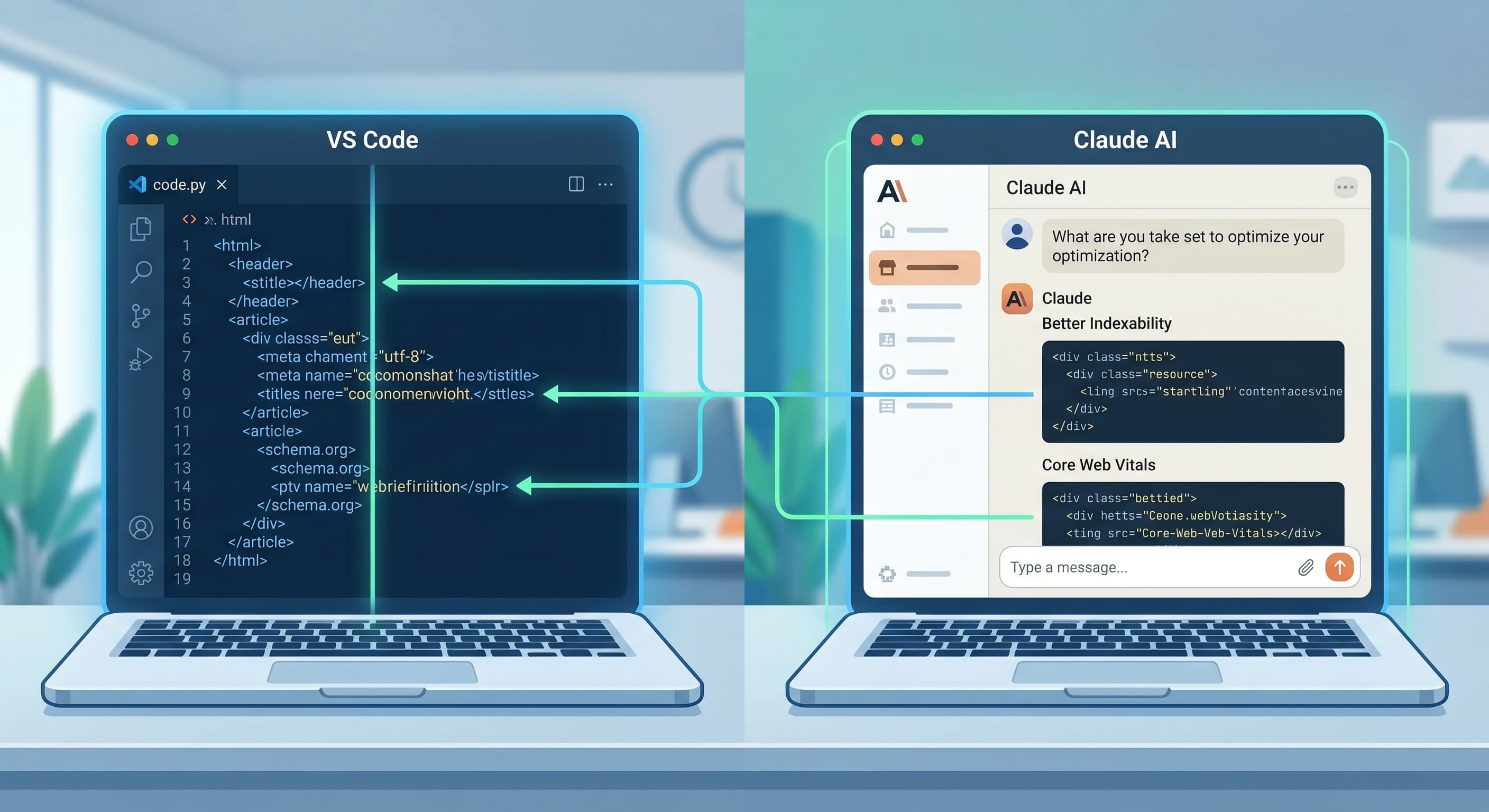
Most technical SEO work is a retrofit — a site ships, then someone audits it months later and finds missing metadata, no structured data, and a Core Web Vitals score that needs a rebuild to fix properly. Building with an AI coding assistant in the editor changes that order: the checklist that used to happen after launch can run while the code is being written, because there's no longer a gap between "write the page" and "know what a page needs to be indexable."
Why this workflow is different from "use AI to write code faster"
Speed isn't the interesting part. The interesting part is that an AI assistant working directly in VS Code has the entire codebase as context — it can see that a page component is missing a metadata export, that an image tag isn't using an optimized image component, or that a new route has no entry in the sitemap, and fix all three in the same pass instead of requiring a separate audit tool to catch them weeks later. This site — seobymasum.com — was built exactly this way, which is as much a proof point as anything written on it.
The technical SEO checklist, built into the workflow
This is the same non-negotiable list any site should satisfy — the difference is doing it as each page is written, not after:
Metadata, per page, not templated once. Every route needs its own title and description generated from its actual content, not a single site-wide template reused everywhere. An AI assistant with the page's content in context can draft an accurate title and description in the same step as writing the page itself.
Structured data matched to content type. A service page gets
Service schema, an article gets BlogPosting, a local page gets
LocalBusiness with a real address — not a single generic schema block
copy-pasted across every route. This is tedious to do by hand consistently
across dozens of pages; it's a natural fit for an assistant that can be
told the pattern once and apply it everywhere.
Semantic HTML and heading structure. One <h1> per page, a logical
heading hierarchy, <nav>/<main>/<article> used for what they
actually mean — easy to get right from the start, surprisingly common to
get wrong at scale without something checking each new page against the
same standard.
Image and font optimization by default. Using an optimized image
component (not a raw <img> tag) and self-hosted/optimized web fonts from
the first commit avoids the entire category of Core Web Vitals problems
that come from unoptimized media accumulating across a site over time.
Sitemap and robots configuration that stays current. A generated sitemap route that reflects actual site structure — rather than a static file someone forgets to update — means new pages are discoverable the moment they ship, not whenever someone remembers to regenerate a file.
Canonical URLs on every route, so indexing consolidates correctly even when the same content is reachable through more than one path.
What this looks like in practice
The workflow is less "ask AI to build a website" and more a tight loop: describe the page and its purpose, let the assistant draft it against the project's existing conventions (the metadata pattern, the schema helpers, the component library already in place), then review the diff before it ships. The AI isn't replacing SEO judgment — it's applying a known, fixed checklist consistently across every page, which is exactly the kind of repetitive correctness that's hard for a person to sustain across a large site and trivial for a model once the pattern is established.
Where the human judgment still matters
An AI assistant doesn't know your actual keyword strategy, which content gaps matter most for your business, or when a schema field should reflect a real business detail rather than a placeholder — which is why AI SEO and technical SEO work still needs a strategist directing it, not a model running unsupervised. The tooling changes how fast the checklist gets executed; it doesn't change who decides what belongs on the checklist in the first place. If you want a site built this way — fast, indexable, and structured correctly from the first commit rather than fixed after the fact — that's the exact workflow behind SEO strategy and consulting engagements here.