
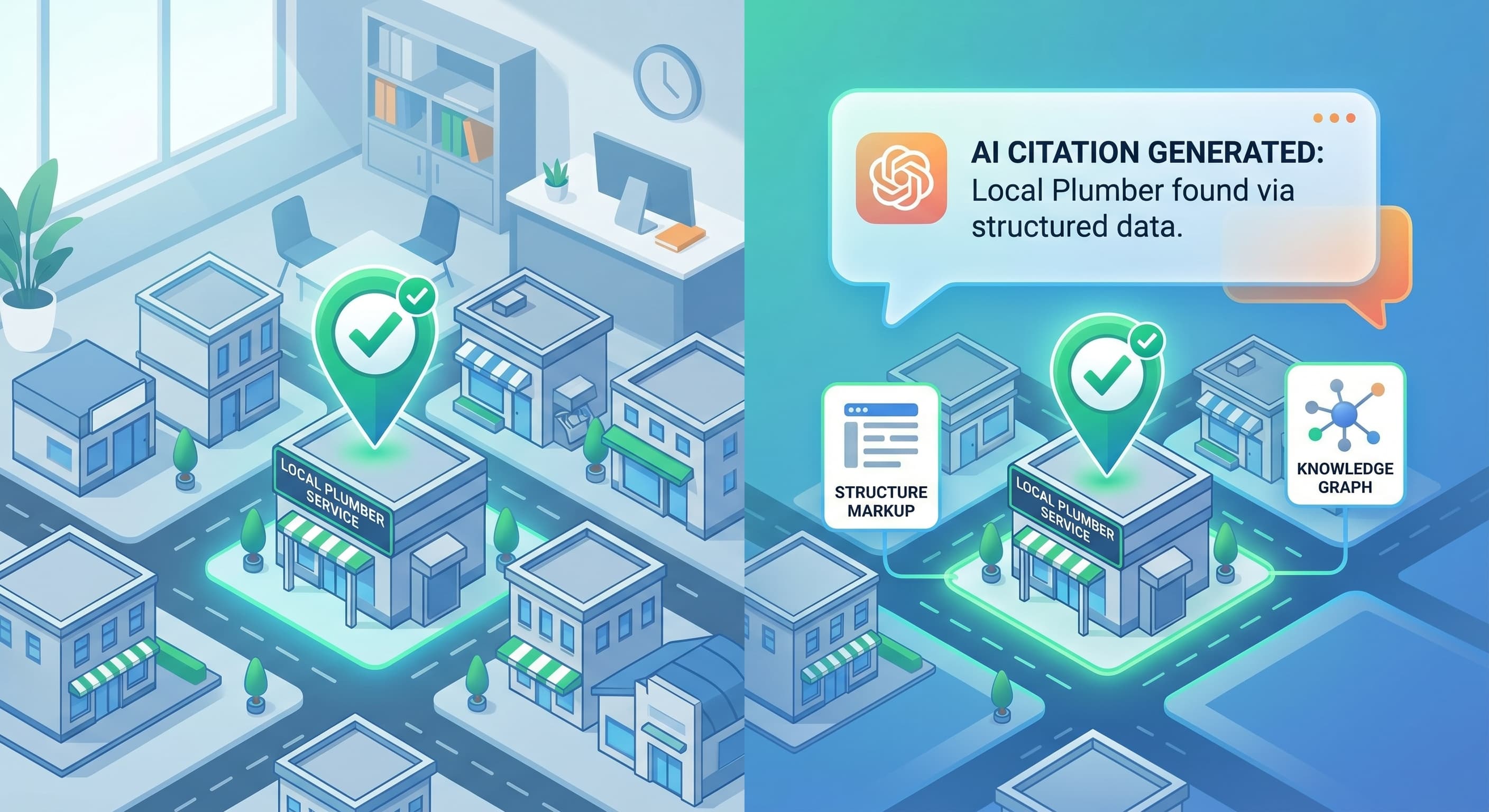
When someone asks ChatGPT or Gemini "who's a good plumber near me" or "best roofing company in [city]," the model isn't guessing from memory — for queries like this, it runs a live web search and pulls from current, structured, consistent information about real businesses. Understanding that mechanism is the entire game for local GEO: you're not optimizing for a crawler that ranks pages, you're optimizing to be the clearest, most consistent answer available when the model goes looking.
How these answers actually get built
ChatGPT and Gemini don't maintain their own local business index the way Google Maps does. For a question with local intent, they typically:
- Recognize the query needs current, location-specific information (not something answerable from training data alone)
- Issue a live web search
- Pull results, which are frequently dominated by Google Business Profile data, directory listings (Yelp, Angi, BBB), and the business's own website — the same sources that already drive local search
- Synthesize an answer, often citing 2-4 sources, favoring the ones with the clearest, most consistent, most specific information
This means local AI visibility isn't a separate discipline from local SEO — it's local SEO plus a few additional things that specifically help a language model extract and trust what it finds.
What actually increases citation odds
NAP consistency across every source the model might pull from. If your business name, address, and phone number don't match exactly across your website, Google Business Profile, and directory listings, a model assembling an answer has to decide which version to trust — or avoid citing you at all rather than risk an inconsistency. This is the single highest-leverage fix for most local businesses, and it's almost always a cleanup project, not a new project.
LocalBusiness structured data on your website. Schema markup gives a model (and a search system feeding it) an unambiguous, machine-readable version of your name, address, service area, phone number, and hours — removing the need to infer that information from prose. A page without structured data can still get cited, but a page with it is handing the model exactly what it needs with zero interpretation required.
Content that answers the real question in plain language. "Best plumber near me" gets synthesized from pages that clearly state what the business does, where, and for whom — not from pages written primarily for keyword density. A service page that opens with "[Business] provides emergency plumbing repair for homeowners in [city] and the surrounding [county] area" is far easier for a model to lift into an answer than one that opens with a generic hero statement and buries the service area three paragraphs down.
FAQ content that mirrors how people actually ask. Models favor content shaped like the question itself. A page with a direct "Do you offer emergency plumbing on weekends?" / answer pair is more extractable than the same information embedded in a paragraph of marketing copy.
A practical checklist for a local service business
This applies directly to the HVAC, plumbing, and roofing businesses this site already works with, and to any local service business generally:
- Audit your business name, address, and phone number across your website, Google Business Profile, and every directory listing you can find — fix every mismatch before doing anything else
- Add
LocalBusinessschema to your website if it isn't already there - Rewrite your homepage and core service page openings to state the service and service area in the first sentence, in plain language
- Build an FAQ section with the actual questions your front desk or dispatcher answers on the phone every week — not invented questions, real ones
- Keep your Google Business Profile category, hours, and service list current — this feeds the same search layer these models draw from
Set expectations honestly
No one can guarantee a specific citation on a specific query from ChatGPT or Gemini — these are generative systems, not a ranking list you can check tomorrow. What consistent NAP data, structured markup, and clear, directly-answerable content do is materially improve the odds: you're removing every reason a model would have to skip over your business in favor of a competitor whose information is simply easier to trust and extract. That's the realistic, honest version of "get cited by AI" — and it compounds with the local SEO work that already improves your visibility in traditional search.